Monday, April 20, 2020

Poetry Part II


Between homework, going outside, and playing games with my family, I enjoy relaxing quiet time alone with my guitars. I took it upon myself to learn some acoustic guitar "Classics" from the likes of the Beatles, Eric Clapton, and others. My one minute covers of these classics can be found here under the playlists tab. When I received my prompt for the next week of poetry, being "Consider something that happens over and over again that you enjoy," I planned to write my Terza Rima on my guitar time.

A Terza Rima has an endless form and was used by great writers, such as Dante, to write much longer works of literature than what I will present, such as The Divine Comedy. The tercets follow a rhyme scheme of aba/bcb/cdc/ded/efe... so on and so forth, until the poet decides to end it with a rhyming couplet (two line stanza), rhyming with the second line of the final tercet. In this case we were instructed to write four tercets before our closing couplet. I have chosen to compose my final tercet so that I can repeat my first line in my couplet. As with the Villanelle, it is written in iambic pentameter. 

Time Spent Picking

By Caleb Gottry

Again I find myself on carpet floor. 

I’m holding finished wood; I strike the steel.
I play a song I know I’ve played before.

I am no longer here alone, I feel,

For Eric, Johnny, Paul, and James have come,
Providing songs that make this day ideal.

Unhappy minors that match my glum

Turn into merry melodies anew,
But can one’s mood be changed by simple strums?

Or is it the guitar that shakes the blues,

Providing joy in isolation, or 
A choice instead of boredom that I do.

For being so alone is such a chore,

Again I find myself on carpet floor.

Poetry Part III

As I mentioned in Part II, I have been spending a lot of time outside to take breaks from homework. I greatly enjoy biking and find myself free from a lot of the worries that this time has brought. My poetry teacher challenged us to write about a personal triumph and given my recent successes on my two wheeler, I embraced the five senses and wrote my sestina.

A sestina is by far the most challenging of the three traditional forms I was tasked to write. First, the poet must choose six end words, all concrete nouns (nouns that you can touch, taste, smell, feel, or see). Each line in the sextet (six line stanza) is seven to ten syllables in length and must follow the order of the end words, which is offset by one each stanza. The poem ends with a tercet where all the six end words are used, two per line. The sestina is typically left untitled. 


Sestina

By Caleb Gottry

Out from the garage he takes his bike.

Then, he starts down the concrete path,
Seeing clouds that might soon drop water.
Apart from his own, there are no faces
As he pedals alone, like a lost child,
Hoping to return to a lemonade.

He rewards himself with that lemonade,

For the work he did on his bike,
Pedaling next to the cars on his path.
For now, he quenches his thirst with water,
Waiting at the light with other faces, 
Maybe next to another lost child.

He hears a “Good morning” from the child

And he wonders if they want lemonade.
He returns the greeting from his bike
And then focuses again on the path,
Along the canal filled with water,
Joined by unfamiliar faces.

The wind blows against these faces.

Among men, he feels like a child,
But he soon forgets the lemonade
And moves past one unfamiliar bike.
A group in line; all focused on the path
Is what he sees, sweating drops of water.

Now he rides through dirt and water,

Conquering this challenge he faces.
Passed by a man, he, just a child
Sees their shirt: yellow, like the lemonade.
Them on faster wheels, but he on his bike,
Together, they forge a new path.

Stop before crossing the asphalt path;

Cars fueled by oil– him, just by water.
The tinted windows hide their faces
And their machines could crush a child.
He’ll have to wait for his lemonade
Until he can cross on his meager bike.

Carried home by bike before sky water.

A phone lights up faces, showing his path,
And the child drinks his lemonade.

Poetry Part I

During this quarantine, I have been learning online from my teachers through Google Classroom. One of my classes has brought forth some creative opportunity during this time: Poetry. For these past three weeks, I have been assigned to write three different poems in three traditional forms. The first of which is a Villanelle.

A Villanelle uses repeating lines in each stanza. In the first stanza, the two repeating lines are introduced separated by a third line that does not repeat, making the rhyme scheme AbA. The rhyme scheme for the following four tercets (three line stanzas) is abA, with the repeating lines (A) alternating each stanza.
The poem ends with a quatrain (four line stanza) with a rhyme scheme of abAA. The poem is written in iambic pentameter, with ten syllables per line alternating unstressed and stressed. The prompt I considered to write my Villanelle was this: "Consider something that happens over and over again that you dislike."


Alarming
By Caleb Gottry

So shut my ears to that unwelcome sound– 

No longer in the crazy world of dreams.
“Why must my eyes be open?” I now frown.

Dark figures sometimes cloud my nights around.

They haunt and scare and cause no sleep for me,
So shut my ears to that unwelcome sound.

Or, in a world where glories do abound,

I find myself in charge of great regimes.
“Why must my eyes be open?” I now frown.

Awake, but I’m not moving from my down.

My dark blue blanket shields the cold extremes, 
So shut my ears to that unwelcome sound.

Asleep in perfect comfort– how profound!

Forgetting abnormality that teems,
“Why must my eyes be open?” I now frown.

Returning to my bed each night, unwound,

I hope to sleep ‘til safety is a theme, 
So shut my ears to that unwelcome sound.
“Why must my eyes be open?” I now frown.

Friday, March 20, 2020

Speak Your Mind!

A fictional short exploring the importance of communication.

Not very long ago, in a small town called σιωπή*, there lived two men. They were known as περήφανος and συνεσταλμένος, but I will refer to them as Phillip and Thomas. The town was utterly quiet and each man was governed only by his own thoughts. Phillip was an unhappy man who was successfully retired, but always assumed everyone had it better than he did. Despite this feeling, however, he never would ask for help with anything, but would sit silently and fill his mind with complaints and self pity. Thomas was a contented man who owned a landscaping service. He was a hard worker and a skilled one, as well. In a short amount of time he could grow and maintain the greenest grass or make a tree yield the ripest fruit. He was always glad to give back to his community in any way he could, but was too afraid to advertise his company to anyone who did not ask.


One hot summer's day, Phillip decided to go for a walk. He could see all the people driving to work in their cars that were nicer than his. He could see mansions rising above the small houses in grand splendor, but Phillip did not appreciate their beauty. He envied it. As he concluded his walk on his own street, he could see the thing that bugged him the most. The greenest grass grew in every yard except his own. Every tree that he could see held the ripest fruit except his own. Phillip tried his best to care for his yard himself, but his feeble body often did not allow such tasks. He knew who the landscaper was, but his pride kept him from knocking on his neighbor's door. Instead, as he did every day, Phillip sat down on his old wooden porch chair and waited for Thomas's offer. 


On this same hot summer's day, Thomas was hard at work. He was in top form that day. The grass had never looked so green and the fruits had never been so ripe. He did his job quickly and while his clients were away at work, lest he receive extensive praise or thanks. As he returned to his own home, he passed the one yard that he had never been asked to work on. His neighbor sat on his porch in an old wooden chair overlooking his unkempt yard. Thomas would have been happy to work on another yard, but his timidness kept him from offering. Instead, as he did every day, he ducked past the home into his own, where he sat down for a meal and waited for Phillip to knock on his door.

-The End-

In the modern world, communication is easy. Sharing one's own thoughts can be done in person or using social media.It can be done publicly or anonymously. It is easy to write one's thoughts down and share them with whoever will read them, even as I am doing right now. It has not always been that way.
My great-uncle likes to tell the story of my great-great-grandfather and one of his sons. They owned a weekly newspaper in Minnesota, with printing presses belt-driven by a single steam engine and hard copies delivered every week. Even though the story above is fictional, it is not that far-fetched. And even though I do not have to publish my thoughts in a factory, I think it is important and enjoyable to write and to speak out one's thoughts openly and honestly for anyone to read or hear, lest the world fall silent. "
πάντοτε ζητεῖν τὴν ἀλήθειαν"-Diogenes Laërtius ("Ever seeking truth")

*Click links for translations

Tuesday, March 17, 2020

COVID-19: In Comparison to the Past

Lately, the corona virus has been causing quite a stir in our society. Our everyday activities are being cancelled one by one "out of an abundance of caution" in an attempt to stop this outbreak. The other day, I went to the grocery store with my dad and there were more people there than on Super Bowl Sunday.
Image result for grocery store in az during coronavirus
Some people, like us, were there to get necessary groceries. Others were in such a state of inner panic about this pandemic that they were stocking up on the essentials like they would never leave the house again in fear of social contact. One man had at least ten California Pizza Kitchen frozen pizzas piled up in his cart. Why? Why do people panic as much as they do about this virus? Should these reactions be expected? In this blog, I will be exploring past reactions to world pandemics, how they compare to the reaction to the corona virus, and raising a thought-provoking question about what the future holds.

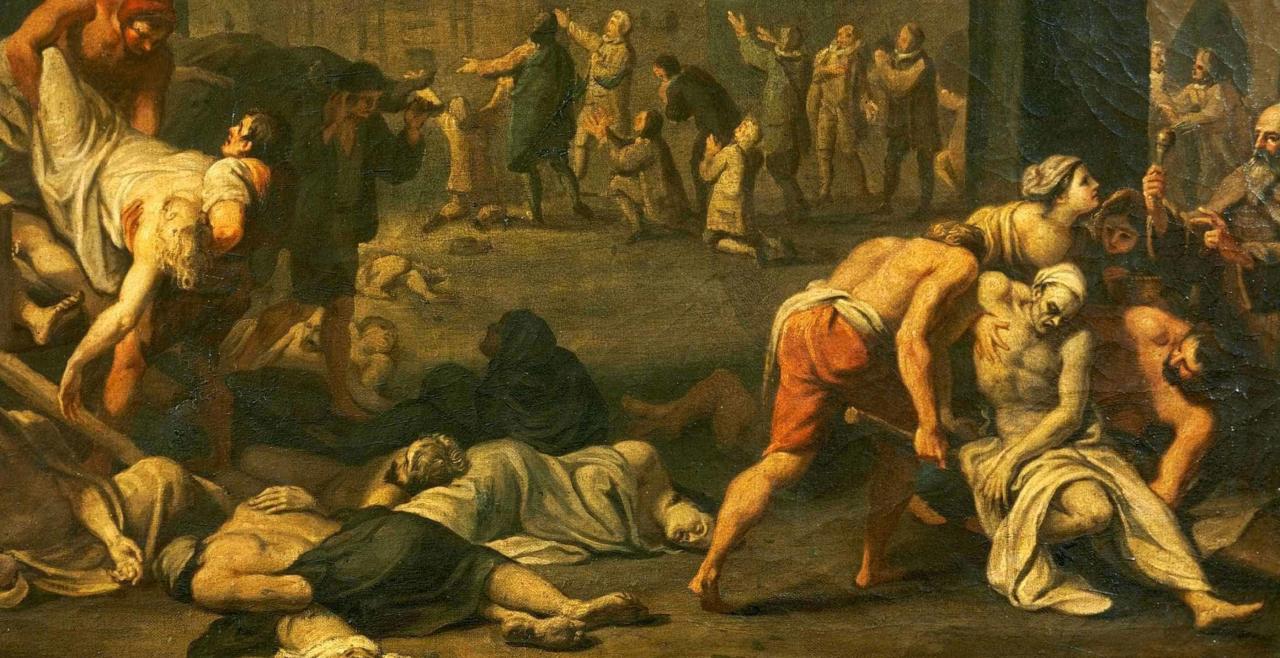
One of the most famous and most deadly pandemics in history was the Bubonic Plague, commonly referred to as the Black Death. The disease was believed to have erupted in central Asia and then spread by fleas and other vectors aboard European trade ships. 

Image result for black death artAlthough medical solutions at the time were often inadequate or non-existent, the European doctors and governmental officials of the 1300s offered sage advice and instruction not unlike modern solutions to COVID-19. Historical medicinal figures, Hippocrates and Galen, offered this advice in Latin: "Cito, longe, tarde," meaning "Leave quickly, go far away, and come back slowly." Recently, we render this advice as social distancing, the reason for many closures of large gatherings across the world. 

In 1347, during the plague's spread to Italy, many ports began to close, and the following year Venice took decisive action in not allowing ships safe harbor if they might carry the disease. As the United States finalizes its closure of international travel, we mirror the past. An eventual food shortage, famine, and economic collapse in Europe in the 1300s may bring light to the instinctual panic in us today in that regard. The quarantine process is not new either. Houses, towns, and communities were set apart for those infected with the plague. How long until our world gets to that point? Our medical advancements and better forms of communication are some of the only advantages the modern world has above the medieval one in stopping a pandemic. 


Finally, the church in Europe took a stand against the Bubonic Plague by proclaiming a faith in the will of God, showing their trust by helping the sick, risking their own lives by staying in infected communities, and praying for forgiveness and for this punishment to end. While the modern churches do not walk up and down the streets whipping themselves as a form of repentance in hope that God will end the suffering of all, the response of unwavering faith in God is still present. Even though churches close their doors to public gatherings, the church body still seeks to help the community at large. In a recent article in the New York Times, Dr. Esau McCaulley writes, "It is possible that, strangely enough, the absence of the church will be a great testimony to the presence of God in our care for our neighbors." 


The Black Death brought about a new era in history and for some new faith and comfort in God. What will the corona virus bring?


Bibliography:


“5e5d05a6fee23d71f4502714.” Steve Saretsky, 11 Jan. 2016, stevesaretsky.com/human-sentiment/5e5d05a6fee23d71f4502714/.


Mccaulley, Esau. “The Christian Response to the Coronavirus: Stay Home.” The New York Times, The New York Times, 14 Mar. 2020, www.nytimes.com/2020/03/14/opinion/coronavirus-church-close.html.


“Science Museum. Brought to Life: Exploring the History of Medicine.” The Black Death and Early Public Health Measures, broughttolife.sciencemuseum.org.uk/broughttolife/themes/publichealth/blackdeath.


“The Black Death.” Historic UK, www.historic-uk.com/HistoryUK/HistoryofEngland/The-Black-Death/.